
Zero-Deposit Car Rental in Rabat: How It Actually Works
1. The short answer
VITI CAR takes no security deposit on any vehicle. Not on a Dacia Logan at 250 MAD a day, and not on the Range Rover Evoque. Nothing is blocked on your card, nothing is held in cash, and there is no amount to chase afterwards.
That sentence is easy to write and worth very little on its own, because plenty of companies advertise "zero deposit" and then produce a card pre-authorisation at handover. So the rest of this article explains exactly how it works, what it does not cover, and how to test the claim when any company — including us — makes it.
2. What a deposit actually is
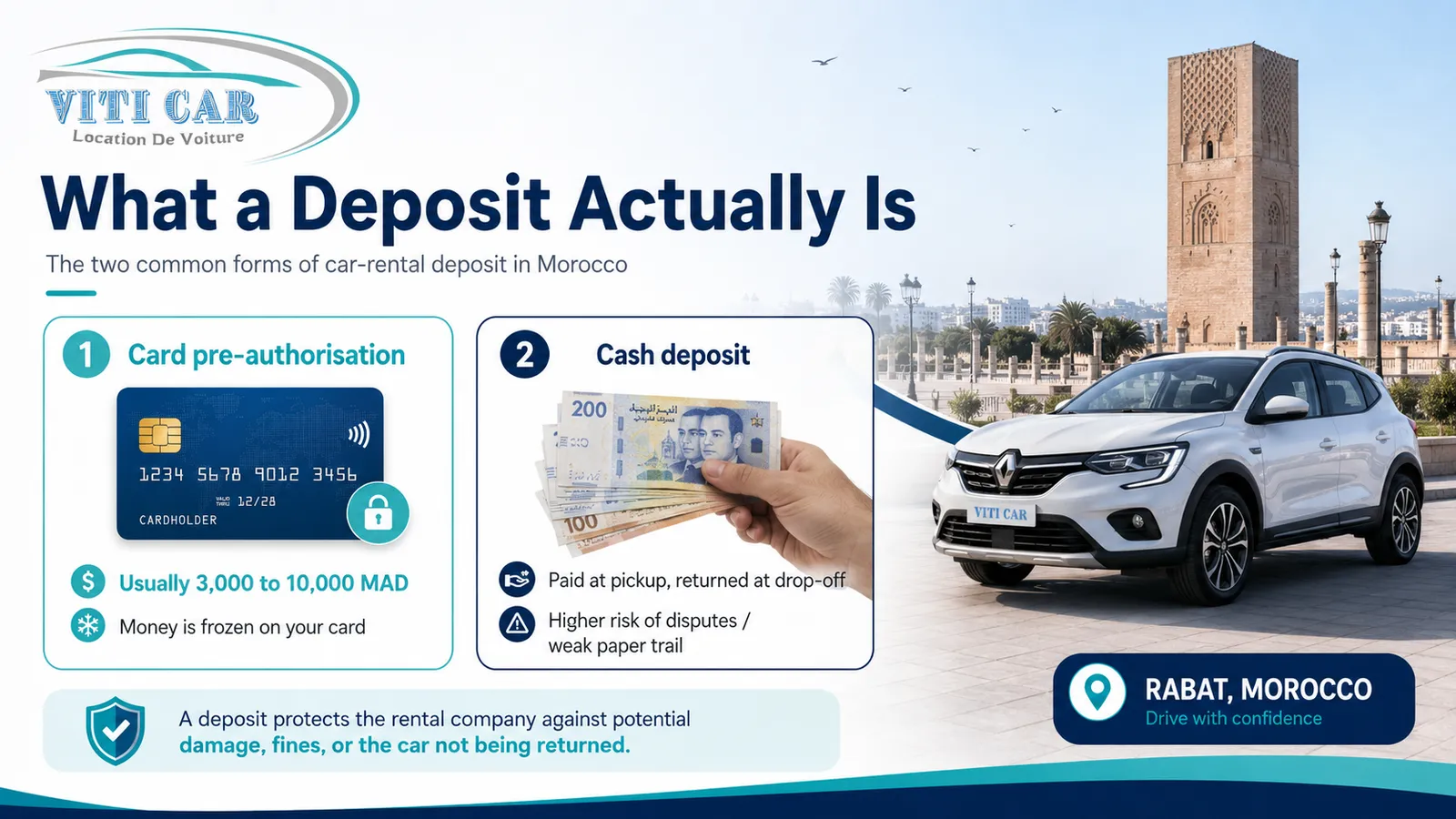
A security deposit is money the rental company holds while you have the car, as protection against damage, fines, or the car not coming back. In Morocco it usually takes one of two forms:
- A card pre-authorisation — typically 3,000 to 10,000 MAD, frozen on your card. The money is not taken, but you cannot spend it.
- Cash — handed over at pickup, returned at drop-off. This is the version that causes the most disputes, because there is often no receipt and no trace.
Neither is unreasonable in principle. A rental company hands a stranger a vehicle worth hundreds of thousands of dirhams and has to manage that risk somehow. The deposit is the industry's default answer.
3. What a deposit really costs you
The obvious cost is the money being unavailable. The less obvious ones matter more:
- It eats your card limit. A 10,000 MAD hold on a card you are also using for hotels and restaurants can leave you declined at the worst moment.
- Release is slow. A pre-authorisation released on the day you return the car can still take one or two billing cycles to reappear. Visitors are usually home before it clears.
- Foreign cards pay twice. A hold and its release can each attract a currency conversion, so you can lose money on a deposit you got back in full.
- Cash deposits have no paper trail. If the amount returned is short, you are arguing about something neither side can prove.
It is the largest single amount you hand over, and with informal operators it is the one most often withheld after return — delayed, disputed, or simply not repaid. Ask for the amount, the method and the release timeline in writing before you book. A company that will not answer that in a WhatsApp message has told you something useful.
4. What we do instead
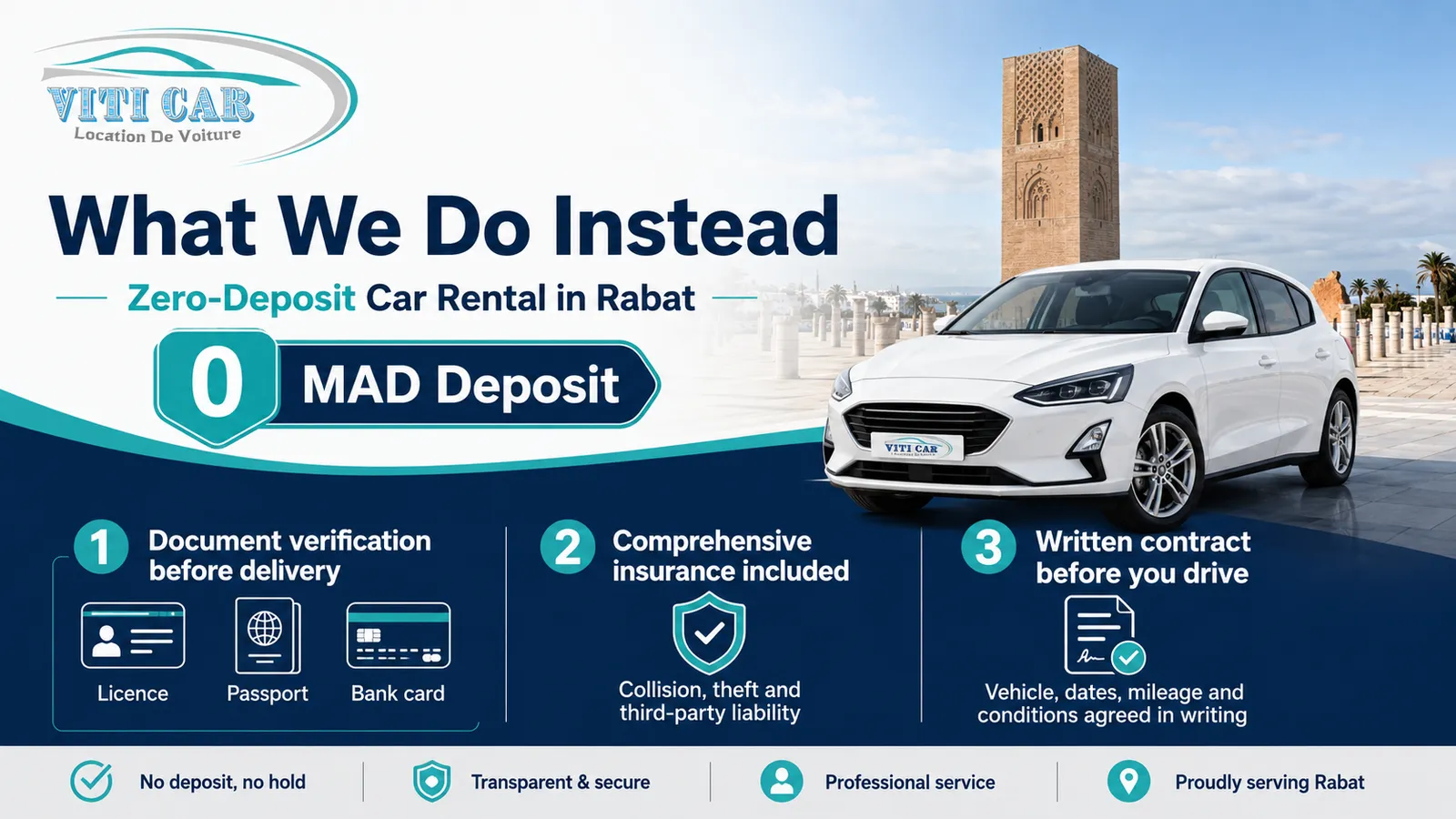
Removing the deposit means replacing what it was protecting against. Three things do that work:
Verification before the car leaves. Your licence, your passport or CIN, and a bank card in your own name are checked before delivery — usually over WhatsApp, so the handover itself takes minutes. The documents required are the standard three, and the checks are the same ones any company runs. We simply do them earlier.
Comprehensive insurance on every vehicle. Every car in the fleet carries collision, theft and third-party liability cover as standard, included in the price rather than sold at the counter. Most of what a deposit exists to cover is already covered.
A written contract before you drive. The vehicle, the dates, the mileage allowance and the conditions are agreed in writing. Both sides know what was promised, which is what actually prevents disputes.
5. What zero deposit does not mean
This is the part most articles about deposits leave out, and it is the part that keeps the promise honest.
You are still responsible for the car. The insurance covers accidents, theft and third-party liability. It does not cover damage caused by negligence, reckless driving, or breaking Moroccan traffic law — and it does not cover traffic fines, which follow the vehicle's registered owner and are passed on to the driver who incurred them. That is set out in our terms and conditions, and it is standard across the industry.
What zero deposit removes is the blocked money, not the responsibility. Anyone telling you a rental carries no obligations at all is either misunderstanding their own contract or hoping you will not read it.
Standard daily rentals include 250 km per day; extra kilometres are charged at the rate written into your contract. Fuel is full to full — you receive the car full and return it full. Neither is unusual, but both are worth reading rather than assuming.
6. How a booking works, step by step
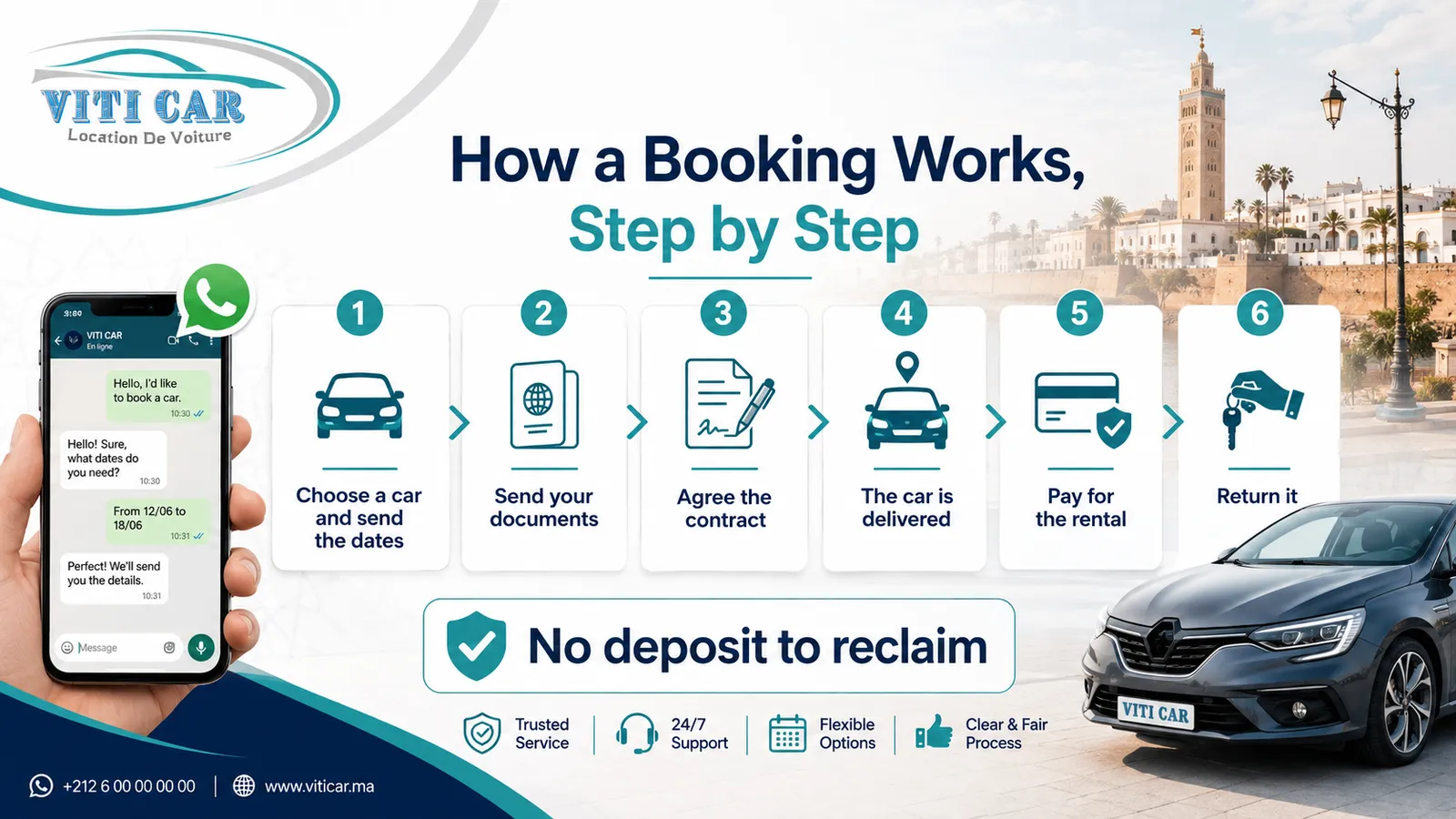
- Choose a car and send the dates. On WhatsApp or through the site. You get a total price, not a daily rate to multiply later.
- Send your documents. Clear photos of licence and ID. This is the verification that replaces the deposit.
- Agree the contract. Vehicle, dates, mileage, conditions — in writing, before anything moves.
- The car is delivered. Free anywhere in Rabat-Salé, including hotels and the airport. Other cities such as Casablanca are arranged for a delivery fee.
- Pay for the rental. The rental period, in full, before or at handover. Nothing beyond that.
- Return it. Same place, or wherever you agreed. No deposit to reclaim, because none was taken.
7. How to check anyone else's zero-deposit claim
Apply this to us as readily as to anyone else. Four questions, all answerable in a message:
- "Will anything be blocked or pre-authorised on my card at handover?" A real zero-deposit policy answers no, without conditions attached.
- "Does that apply to this specific car?" Some companies waive deposits on economy cars only, then reinstate them on anything larger.
- "Is the insurance included, and what is the excess?" Zero deposit with a large insurance excess simply moves the risk rather than removing it.
- "Can I see the contract before the car arrives?" If the contract only appears at handover, when you are on a pavement with your luggage, you have lost your leverage to read it properly.
Our article on avoiding rental scams in Morocco covers the wider pattern — the withheld deposit is one of four problems that recur, and they tend to travel together.
Renting without a deposit in Rabat or Salé?
20 vehicles, from economy city cars to a nine-seat people carrier, from 250 MAD/day. No deposit on any of them, comprehensive insurance included, free delivery across Rabat-Salé, and a written contract before the car moves.
Ask on WhatsApp8. Frequently Asked Questions
Do I need a deposit to rent a car in Morocco?
At most companies, yes — usually 3,000 to 10,000 MAD, either blocked on your card or taken in cash. At VITI CAR no deposit is taken on any vehicle in the fleet.
Is anything blocked on my credit card?
No. The card is checked to confirm it is in your name, but nothing is frozen or pre-authorised. You pay for the rental period and nothing else.
Does zero deposit apply to every car?
Yes — every vehicle, from the cheapest city car to the most expensive SUV. There is no category where a deposit returns.
What happens if I damage the car?
Comprehensive insurance covers collision, theft and third-party liability. You remain responsible for damage caused by negligence, reckless driving or breaking traffic law, as set out in the terms. Report any incident immediately — that is what protects both sides.
Who pays a traffic fine?
The driver. Fines are issued against the vehicle and passed to whoever was driving at the time. Zero deposit does not change that.
Can I pay in cash?
Yes. Payment for the rental period is due before or at handover. Ask your concierge which methods are available for your booking.
Why can you do this when others cannot?
Because the risk is managed differently rather than ignored: documents verified before delivery, comprehensive insurance included as standard, and a written contract agreed in advance. It costs more effort up front and less argument afterwards.